How Does It Work?
There are four major approaches to divorce.
| Direct Negotiation | |
 In this approach the partners to the marriage attempt to negotiate the dissolution of the marriage, agree on what is and what is not marital property, determine the division of marital property and rights, and agree on responsibilities for the support and nurture of minor children--without direct involvement of counselors or attorneys. This approach is feasible but often difficult in light of the causes contributing to deterioration of the relationship. This is considered an uncontested divorce since both parties agree on the terms. However, the provisions made for the support and care of minor children must receive court approval. |
|
| Mediation | |
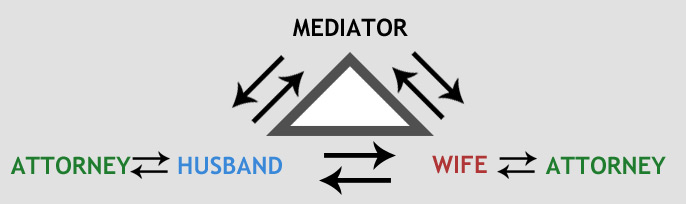 In mediation the parties retain the services of a professional mediator. This person, who may or may not be an attorney, meets with the parties, establishes an agenda of issues to be addressed, and works with both parties to arrive at a set of agreements covering all aspects of the separation/divorce. The parties advocate for themselves. The mediator's role is a neutral one. The mediator guides and facilitates the process. He or she does not represent either party, and cannot give either party advice or assist either party in advocating their position. After a preliminary agreement has been developed, each party reviews it with his and her individual attorney to determine whether that person's interests have been represented adequately. Often, the findings of those consultations result in a return to mediation sessions. The final agreement is presented to the court as an uncontested divorce, again subject to court approval, particularly regarding child care matters. |
|
| Traditional Adversial Litigation | |
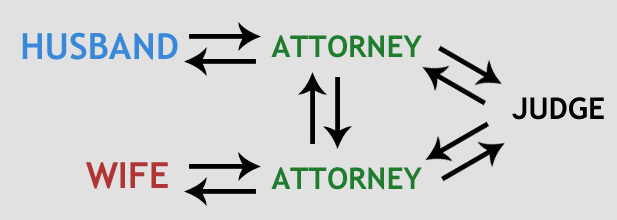 In adversarial proceedings both parties hire attorneys. The attorneys are major players. Virtually all communication is between the attorneys. Each side seeks advantage over the other side, with the aim to leave the marriage with the most marital property and rights, and the least responsibility for marital liabilities. Disputes regarding the value of marital assets are addressed by hiring outside experts to value the asset. If the parties and attorneys cannot agree on a common expert, each side retains their own experts. This approach to divorce, while sometimes necessary, is often financially expensive, protracted in nature, emotionally exhausting and destructive of any vestiges of a relationship between the parties. This is an important consideration when there are children to consider. Privacy is also a casualty. Unless specifically sealed by the court, proceedings are open to public scrutiny. If the parties, through their attorneys, can arrive at agreement on the various issues before them, their agreement is presented to the court by the attorneys for approval as an uncontested divorce. If the parties are not able to reach agreement, then the case is scheduled for trial. From this point forward the attorneys direct the process; they communicate with the court. The final outcome is determined not by the divorcing parties, and not by the attorneys. The final outcome is dictated by the court. Essentially, in adversarial proceedings the parties communicate with their individual attorneys. The attorneys communicate with each other. Both during the process--in the case of interim orders--and in the stage of final resolution, the attorneys communicate with the court. The court, in turn, communicates with the attorneys. The principals to the divorce have diminished control over the process or the outcome. The outcome, and everything that contributed to it, are often a matter of public record. |
|
| Collaborative Divorce | |
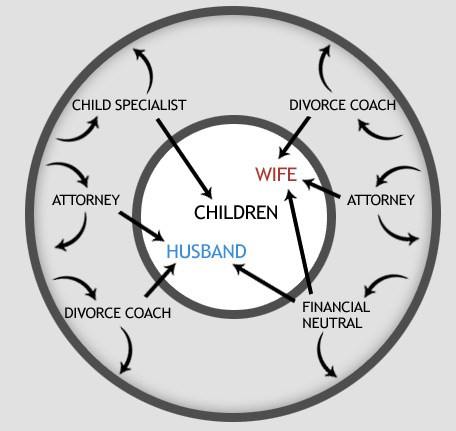 Collaborative divorce has been available in some parts of the country for over a decade. Specially trained family law attorneys offer this option. Each spouse hires a family lawyer committed to, and specially trained in, devising creative "win-win" agreements. All negotiations take place face-to-face. The cornerstone of this approach is an agreement signed by both divorcing parties and their attorneys stating that all parties are committed to working together to negotiate a fair and equitable dissolution of the marriage--without going to court to do so. The agreement usually includes binding commitments to good-faith negotiating, full disclosure, acknowledgment of the needs of the other party, protection of the children, and avoidance of court proceedings. Other professionals (accountants, financial analysts, child development specialists, appraisers, etc.) are retained jointly and work as neutrals. In the event the parties later decide to litigate the attorneys withdraw. The parties must retain new legal counsel. Also, all outside experts, e.g., financial analysts, CPAs, child development specialists, etc. involved in the collaborative process are barred from testifying in court on behalf of either partner. |
|
What's so special about this approach to divorce?
Experienced collaborative lawyers will tell you that there is a big difference between a settlement that is negotiated during the conventional litigation process, and a settlement that takes place in the context of an agreement that there will be no court proceedings or even the threat of court. Most conventional family law matters settle figuratively, if not literally, "on the courthouse steps". By that time, a very great deal of money has been spent, and a great deal of emotional damage can have been caused. The settlements are reached under conditions of considerable tension and anxiety, and both "buyer's remorse" and "seller's remorse" are common. Moreover, the settlements are reached in the shadow of trial, and are generally shaped largely by what the lawyers believe the judge in the case is likely to do. Nothing could be more different from what happens in a typical Collaborative Law settlement. The process is geared from day one to make it possible for creative, respectful collective problem-solving to happen. It is often quicker, less costly, more creative, more individualized, far less stressful, and overall far more satisfying in its results than what occurs in most conventional settlement negotiations.
Collaborative Law is the best choice for couples who share a commitment to settlement, have the ability to compromise and see the other's point of view, and want the advantages of specialist legal advice and problem-solving built into the settlement process. It can help spouses arrive at creative settlements even when the problems are complex. It is especially useful when spouses hesitate to negotiate face to face with only a neutral mediator in the room; collaborative negotiations are always conducted with a skilled advocate's active assistance. The settlement results can often be more creative than in other models, because neither lawyer succeeds in the job she or he was hired for unless both spouses' legitimate needs are met in the settlement.
Why is Collaborative Law such an effective settlement process?
Because the collaborative lawyers have a completely different state of mind about what their job is than traditional lawyers generally bring to their work. We call it a "paradigm shift." Instead of being dedicated to getting the largest possible piece of the pie for their own client, no matter the human or financial cost, collaborative lawyers are dedicated to helping their clients achieve their highest intentions for themselves in their post-divorce restructured families.
Collaborative lawyers do not act as hired guns. Nor do they take advantage of mistakes inadvertently made by the other side. Nor do they threaten, or insult, or focus on the negative either in their own clients or on the other side. They expect and encourage the highest good-faith problem-solving behavior from their own clients and themselves, and they stake their own professional integrity on delivering that, in any collaborative representation they participate in.
There is another way that the collaborative process differs profoundly from the adversarial process: collaborative lawyers trust one another. They still owe a primary allegiance and duty to their own clients, within all mandates of professional responsibility, but they know that the only way they can serve the true best interests of their clients is to behave with, and demand, the highest integrity from themselves, their clients, and the other participants in the collaborative process.
Collaborative Law offers a greater potential for creative problem-solving than does either mediation or litigation, in that only Collaborative Law puts two lawyers in the same room pulling in the same direction to solve the same list of problems. Lawyers excel at solving problems, but in conventional litigation they pull in opposite directions. No matter how good a lawyer I am for my own client, I cannot succeed as a Collaborative Lawyer unless I also can find solutions to the other party's problems that my client finds satisfactory. This is the special characteristic of Collaborative Law that is found in no other dispute resolution process.
When is Collaborative Law a good option?
Collaborative law is often the best choice for couples who share a commitment to settling their differences between themselves rather than engaging in legal combat, have the ability to compromise and see the other's point of view, and want the advantages and benefits of specialized legal advice and problem-solving built into the settlement process. It can help spouses arrive at creative solutions that address complex problems. When spouses hesitate to negotiate face to face with only a neutral mediator in the room this process can be especially useful; collaborative negotiations are always conducted with skilled advocates present, providing active assistance. The settlement results can often be more creative than in other models, because neither lawyer succeeds in the job she or he was hired for unless both spouses' legitimate needs are met in the settlement.
Is this a good option for you?
Collaborative divorce isn't for everyone. It may be a good option for you to explore if some or all of the following are true for you:
| Is this a good option for you? | |
| Collaborative divorce isn't for everyone. It may be a good option for you to explore if some or all of the following are true for you: | |
 |
|
 |
You want a civilized, respectful resolution of the issues. |
|
|
|
You would like to keep open the possibility of friendship with your partner down the road. |
|
|
|
You and your partner will be co-parenting children together and you want the best co-parenting relationship possible. |
|
|
|
You want to protect your children from the harm often done to children by adversarial divorce proceedings. |
|
|
|
You and your partner have a circle of friends and extended family in common that you both want to maintain relationships with after the divorce. |
|
|
|
You have ethical or spiritual beliefs that place high value on your personal responsibility for dealing fairly with others, even where conflict is involved. |
|
|
|
You value privacy in your personal affairs and do not want details of your family assets, liabilities, dealings or agreements to be available in the public court record. |
|
|
|
You value independent control over the decision-making that affects your life and do not want to hand over decisions about your financial and/or child-rearing arrangements to a third party, i.e., a judge. |
|
|
|
You recognize the restricted range of outcomes and "rough justice" generally available in the public court system, and want a more creative and individualized range of choices available to you and your spouse or partner for resolving your issues. |
|
|
|
You place as much or more value on the relationships that will exist in your restructured family situation as you place on obtaining the maximum possible amount of money for yourself. |
|
|
|
You understand that conflict resolution with integrity involves achieving not only your own goals but also finding a way to achieve the reasonable goals of the other person. |
|
|
|
You want to continue with the next chapter of your life with as much possible energy and as little psychic damage and baggage as possible--you want the divorce process to be a stepping stone rather than a stumbling block to your future. |